
















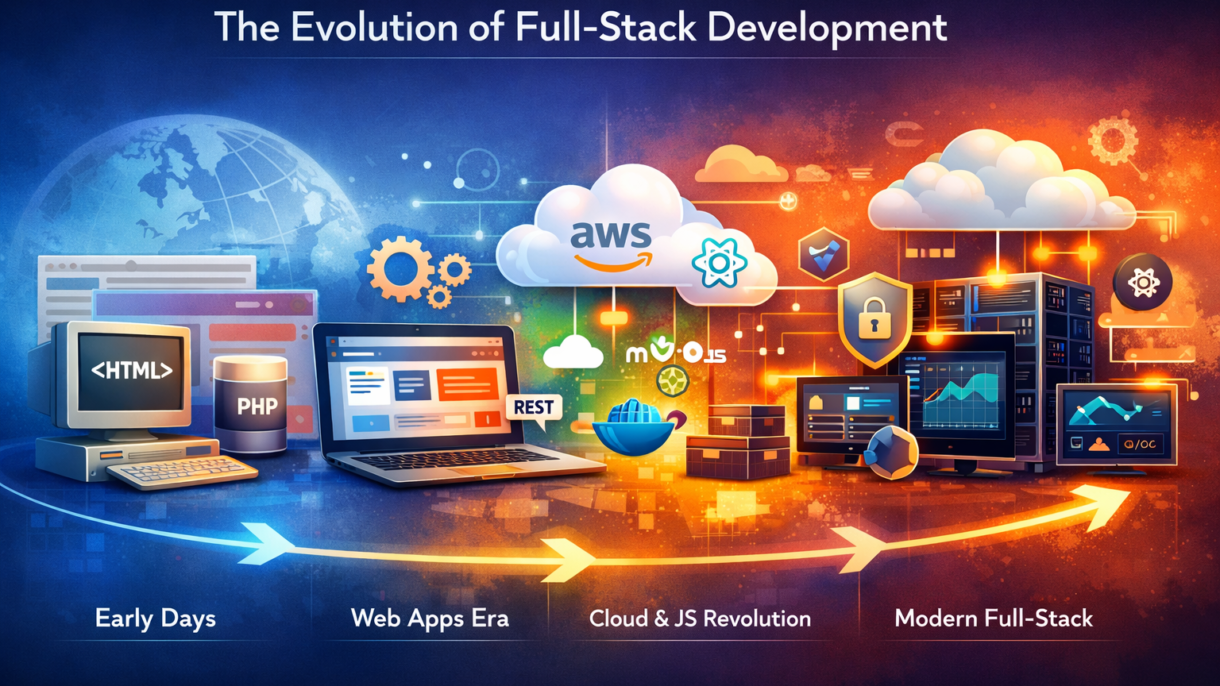

Amidst the ever-changing landscape of software engineering, one role that has seen some massive changes is that of the full-stack developer. The simple requirement of managing the front-end and back-end components has transformed into an intricate discipline of cloud computing, distributed computing, security, and DevOps principles.
The development process in itself is not only about technological advancements; it is also about meeting the needs of the industry that requires engineers capable of filling the gap between solution design and solution delivery. This is where the expertise of Neeraj Kaushal in the field of solution architecture and distributed computing comes into play.
The Early Days: Static Pages and Simple Scripts
However, in the late ’90s and early ’00s, web development was very simple. The full-stack developer would be working with:
HTML, CSS, and JavaScript on the front-end side;
either PHP, ASP, or Java servlets on the back-end side; and
A database management system such as MySQL or SQL Server.
The stack was minimalistic, and people did not expect much. Most of the time, developers were expected to create either static or slightly dynamic websites.
The Rise of Rich Web Applications
In the mid-2000s, the evolution of the web went towards the development of interactive web applications. Such platforms as Ruby on Rails, Django, and ASP.NET MVC brought structural backend coding, and AJAX was the technology that empowered dynamic frontend development.
The job of full-stack developers at that time included:
Operating the MVC frameworks.
Dealing with RESTful APIs.
Working with such JavaScript libraries as jQuery.
It is the epoch when the attitude of a “problem solver” developer appeared.
The Cloud & JavaScript Revolution
The 2010s saw two significant changes: the rise of cloud computing and the explosion of the JavaScript ecosystem.
Node.js made it possible for JavaScript to be run on the server-side, allowing the same programming language to be used throughout the entire stack.
Frameworks like Angular, React, and Vue.js turned front-end development into a very specialized discipline.
Platforms such as Azure, AWS, and Google Cloud Platform brought features like scalability, serverless computing, and containerization.
Full-stack engineers were not merely programmers anymore; they were system architects.
Modern Full‑Stack: Security, Reliability, and Scale
Currently, full-stack development is not just coding anymore. Full stack development today includes:
Security – OAuth2, JWT, identity management.
Reliability – Messaging using tools like RabbitMQ or Kafka and retry, idempotency patterns.
Monitoring – Prometheus, Grafana, Application Insights.
DevOps – GitHub Actions, Jenkins, Terraform, automated deployments.
Consumers demand applications that are safe, scalable, and resilient. A full-stack developer needs to have the approach of a solution architect.
The Role of Neeraj Kaushal
Having worked for over 15 years in areas of solution architecture, distributed systems, and full-stack development, Neeraj Kaushal provides services which are a result of his growth. His expertise includes:
Designing cloud-based applications on Azure, AWS, and GCP.
Implementing secure APIs and identity services.
Creating highly available distributed systems with messaging and observability.
Coaching DevOps & CI/CD best practices.
From an organization’s point of view, this translates into working with a professional who is well-versed in not only technology but also the value of technology choices.
The Future of Full‑Stack Development
Future Trends of the Full Stack Developer Role
The future trends of the full-stack developer role will involve:
AI-assisted coding with intelligent tools for developers.
Low code/no code tools that facilitate quick deployment.
Edge computing that enables localized experience at high speed.
Security and compliance in a distributed environment.
Conclusion
The history of full-stack development can be viewed through the lens of the history of the internet – from simple websites to smart, distributed, and cloud-based systems. Full-stack developers today are more than just developers; they are partners in the process of digital transformation.
Neeraj Kaushal demonstrates through his work the progress of a full-stack developer’s career path.